
Separate Cortland County Value Numbers
Not every number labeled "value" measures the same thing. An assessment drives the tax system. A market estimate guesses at what a property might fetch. A recorded transfer reports the consideration actually filed with a deed. Those answers carry different dates too. A Cortland County value lookup works best when it preserves the label each source prints rather than flattening everything into one "value."
| Value type | Meaning | Recorded in |
|---|---|---|
| Assessed value | Value placed on the roll for assessment purposes | Municipal assessment roll |
| Market or equalized indicator | Assessment interpreted with the stated level or rate | Roll and equalization material |
| Last sale consideration | Amount reported with a particular transfer | Deed index, transfer record or Beacon sale field |
None of these figures is a current appraisal. A careful comparison records the roll year, valuation date, taxable-status date, property class, exemptions, parcel history and sale date so each number stays in context.
Look Up an Assessed Value in Cortland County
Start with the right city or town assessment roll. Searching by tax-map number beats an address or owner name, since both can change over time. Confirm the municipality, situs and property class first. Then copy the land assessment, total assessment, exemption amounts and taxable values, along with the uniform percentage or equalization context printed for that roll.
- Identify the legal municipality and assessment roll.
- Match the parcel ID and property location.
- Capture land, total and taxable assessment fields.
- Record the roll year, valuation date and taxable-status date.
- Compare a sale only after matching the same parcel configuration.
The three-date test does the real work. A deed can be recorded well after the value date. Meanwhile the roll may still list an older owner or an older condition. Resist forcing the dates into one "current" number.
Use Beacon as a Cortland County Value Index
The county's Beacon Online page advertises a broad index of value-related material: assessment values, property location, owner of record, sale information, physical characteristics, photos, deeds or surveys, tax maps and deed book and page references. Subscriptions run $15 for two weeks, $30 monthly or $300 yearly for one user. For official roll fields, though, the published assessment rolls remain the direct public reference.
The county landing page tells you what the service advertises. Before citing a specific property value, save the selected parcel result and its access date.
Apply Cortland County Assessment Dates
The county calendar anchors everything. Valuation falls on July 1 of the prior year. Taxable status is fixed on March 1. The tentative roll follows on May 1. Grievance day lands on the fourth Tuesday in May. The final roll carries a July 1 date. That sequence explains why a value can lag a recent renovation, split, sale or change in exemption. The City of Cortland adds its own layer. The city completed a revaluation effective with the 2024 assessment roll. A prior reassessment was effective January 2008. City material described March 1, 2024 notices and an informal administrative review route. That history matters: any jump crossing the revaluation cannot be read as though the assessment basis stayed constant.
Read the Cortland Valuation and Taxable-Status Calendar
The county key-dates page lays each stage in order. It shows which condition of the parcel a given roll reflects.
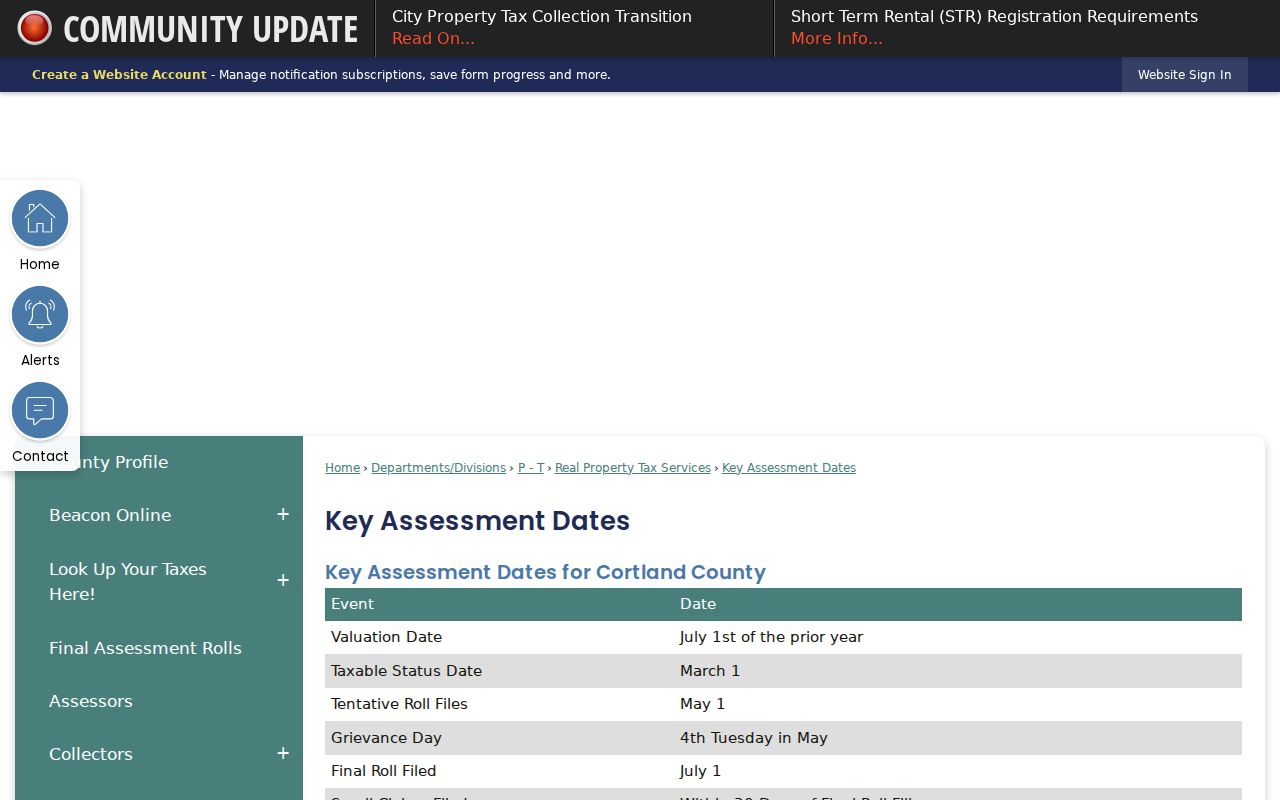
The key-dates display links valuation, taxable status, tentative publication, grievance and final-roll dates in one sequence. Always pair it with the year printed on the municipal roll you are reading.
Distinguish Assessed From Taxable Value
Total assessed value is not always the base every tax rate touches. Exemptions can shrink one or more taxable columns. Different taxing purposes may show different taxable amounts. Copy each field with its exact label. If the roll already prints the resulting taxable value, do not subtract the exemption again. Property class, special districts and municipal assessment practice matter too. Two homes with nearly identical total assessments can still produce different bills. The bill itself belongs on the tax-record page rather than in a value comparison. For valuation work, note exemptions only to explain why taxable value falls below assessed value.
Interpret the 97 Percent City Equalization Context
Cortland County's 2025 equalization material lists the City of Cortland at 97.00, and the 2025 City roll sample carries the same uniform percentage. That figure supplies assessment context for that municipality and that year alone. Copying it to another town or roll year without checking the applicable state and county material invites error. An equalization rate exists to support fair comparisons across assessing units and certain tax calculations. It does not predict any particular sale price. Keep the original assessment, the applicable rate and any derived figure in separate columns, so it stays clear which number came from the roll and which was calculated.
Compare Recorded Sales With Care
A deed or transfer record can supply both consideration and a recording date. Beacon advertises sale information and comparable searching. But the live result and subscription behavior must be checked at the time of use. Before treating a transfer as comparable, confirm several things. Check property class, lot size, improvements, municipality, sale conditions and parcel history.
A quitclaim may not reflect an open-market price for one parcel. The same goes for a family transfer, estate distribution, partial-interest deed or multi-parcel transfer. A lot split or merger can break a year-over-year series just as cleanly. Read the instrument and any referenced map. Never infer market value from a bare index amount.
What a Cortland County Property Value Cannot Prove
An assessment supports taxation. A reported consideration describes one recorded event. A market estimate hinges on method and date. None of them proves what a buyer would pay today, the physical condition of improvements, clear title, a surveyed boundary, or the absence of liens.
Value limit. An assessed value is not an appraisal and is not a promise of the parcel's current sale price.
For a defensible research note, cite the source, the date, the parcel number, the municipality, and the exact field name. A licensed appraiser handles appraisals. The assessor answers questions about the roll.
The Values on a Cortland County Property Record
| Value | What It Is | Where |
|---|---|---|
| Assessed value | ||
| Market / appraised value | ||
| Last sale price | ||
| Land vs improvement |
Looking Up a Cortland County Property Value
- Assessed value
- Market / appraised value
- Level of assessment
What a Cortland County Assessor Value Is Not
Value vs price. [1-2 sentences - a Cortland County assessor value is not what a property will sell for; for a sale or loan, get a licensed appraisal.]